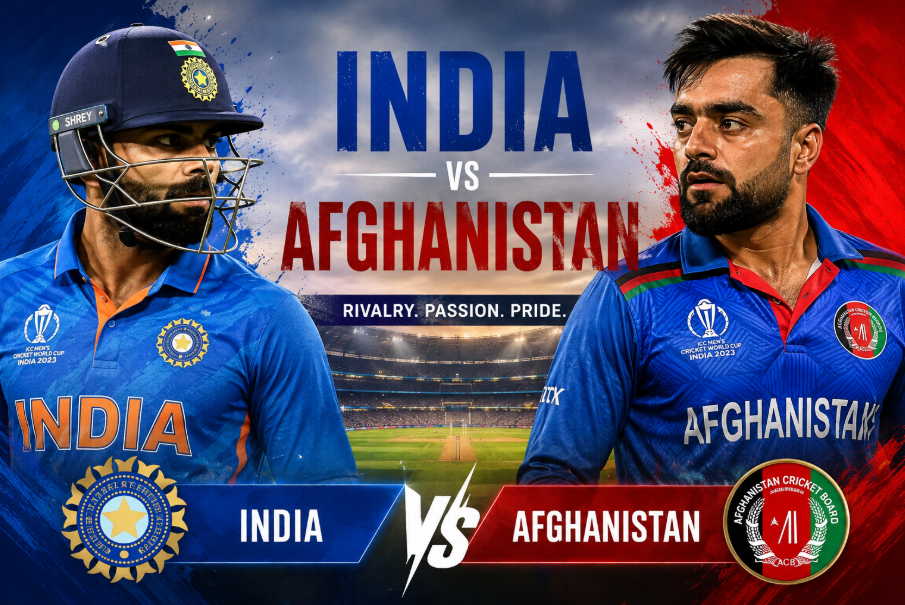
The rivalry between the India National Cricket Team and the Afghanistan National Cricket Team is a modern cricket story built on contrast, growth, and rising respect. India entered this matchup as one of the most dominant forces in world cricket, packed with experienced match winners and deep tactical strength. Afghanistan, on the other hand, arrived with the hunger of a developing cricket nation determined to prove itself on the global stage. What began as a one sided contest gradually transformed into a more competitive and emotionally charged fixture. Across Asia Cup clashes, World Cup meetings, and bilateral games, the scorecards reveal India’s dominance, but also Afghanistan’s steady progress. This journey is not just about results, it is about evolution, resilience, and the changing balance of international cricket power.
Head to Head Summary All Formats
Format [1]
Total Matches
India Wins
Afghanistan Wins
Ties
No Result
Test
2
2
0
0
0
ODI
4
3
0
1
0
T20I
9
8
0
0
1
Total
15
13
0
1
1
ICC Team Rankings
Format
India Rank
India Rating
Afghanistan Rank
Afghanistan Rating
Test
3
104
Unranked
ODI
1
118
7
93
T20I
1
10
Test Stats
Date
Venue
Winner
Margin of Victory
June 2018
Bengaluru
India
Innings and 262 runs
June 2026
New Chandigarh
India
Innings and 300 runs
ODI Stats
Date
Tournament or Series
Winner
Margin Details
March 2014
Asia Cup
India
India won by 8 wickets
September 2018
Asia Cup
Tied
Match tied
June 2019
ICC Cricket World Cup
India
India won by 11 runs
October 2023
ICC Cricket World Cup
India
India won by 8 wickets
T20 Stats
Date
Tournament or Series
Winner
Margin or Status
May 2010
ICC T20 World Cup
India
India won by 7 wickets
September 2012
ICC T20 World Cup
India
India won by 23 runs
November 2021
ICC T20 World Cup
India
India won by 66 runs
September 2022
Asia Cup
India
India won by 101 runs
October 2023
Asian Games Final
No Result
Abandoned due to rain
January 2024
Bilateral Series
India
India won by 6 wickets
January 2024
Bilateral Series
India
India won by 6 wickets
January 2024
Bilateral Series
India
Tied, India won via Super Over
June 2024
ICC T20 World Cup
India
India won by 47 runs
Early Encounters and First Impressions
The early meetings between India and Afghanistan set the foundation of a one sided but evolving cricket relationship. India entered these contests as a global powerhouse with deep batting strength and world class bowling options, while Afghanistan arrived with raw energy and fearless intent. The first matches showed clear dominance from India, especially in controlling middle overs and handling pressure situations. Afghanistan, however, earned respect through disciplined bowling spells and fighting spirit in batting collapses. The scorecards from these games reflected large margins, yet they also revealed glimpses of Afghanistan’s potential. India used these encounters to test bench strength and experiment with combinations, while Afghanistan focused on learning from elite opposition. Over time, even in defeat, Afghanistan began reducing the margin of losses, signaling the beginning of a more competitive future in this rivalry.
Season
Match
Score
Winner
Key Performance
2014
Asia Cup Group
IND 254/6 vs AFG 136/9
India
Rohit Sharma 56, Shami 3 wickets
2018
Test Match
IND 474 vs AFG 109 & 103
India
Ashwin 8 wickets
2019
ODI Match
IND 252/8 vs AFG 245/8
India
Dhoni 52*, Nabi 2 wickets
2021
T20 Match
IND 210/2 vs AFG 144/7
India
Rahul 68, Bumrah 2 wickets
Afghanistan Rise and Competitive Growth
Afghanistan’s rise in world cricket reshaped the nature of their contests with India. Initially seen as underdogs, they gradually built a reputation through exceptional spin bowling and fearless batting in pressure situations. Players like Rashid Khan and Mohammad Nabi brought world class control in the middle overs, making Afghanistan a dangerous opponent in shorter formats. India began respecting their bowling attack more seriously, especially in T20 and ODI formats where Afghanistan could restrict scoring rates effectively. The scorecards started showing smaller margins, even when India won comfortably. Afghanistan’s improved fielding standards and better game awareness also contributed to tighter contests. This phase of the rivalry reflects a shift from predictable dominance to tactical engagement, where India could no longer take early overs lightly. Afghanistan’s progress turned every match into a learning battle and slowly into a genuine competitive fixture.
Season
Match
Score
Winner
Key Performance
2015
ODI
IND 300/5 vs AFG 230/9
India
Kohli 99, Rashid 2 wickets
2017
ODI
IND 268/7 vs AFG 201/8
India
Shikhar Dhawan 80
2019
ODI
IND 252/8 vs AFG 245/8
India
Nabi 52, Bumrah 3 wickets
2022
T20
IND 111/2 vs AFG 110/8
India
KL Rahul 50*, Rashid 1 wicket
Asia Cup Battles and Tactical Evolution
Asia Cup encounters between India and Afghanistan became crucial turning points in the rivalry. These matches brought high pressure environments where Afghanistan often challenged India’s batting depth with tight spin bowling and disciplined line and length. India, on the other hand, adapted by strengthening middle order stability and rotating strike more efficiently against spin attacks. The scorecards from Asia Cup games show India maintaining upper hand but not without resistance. Afghanistan’s bowlers frequently restricted scoring in the middle overs, forcing India to rebuild innings carefully. Tactical battles between Indian batters and Afghan spinners became a defining feature of these games. Each Asia Cup meeting added new layers of strategy, making India more cautious and Afghanistan more confident. This stage of the rivalry highlighted Afghanistan’s transition from participants to genuine competitors capable of influencing match flow.
Season
Match
Score
Winner
Key Performance
2014
Asia Cup
IND 254/6 vs AFG 136/9
India
Rohit 56, Shami 3 wickets
2018
Asia Cup
IND 252/5 vs AFG 252/8
Tie
Ravindra Jadeja 3 wickets
2022
Asia Cup
IND 212/2 vs AFG 111/8
India
Kohli 122*, Bhuvneshwar 5 wickets
2023
Asia Cup
IND 213/2 vs AFG 212/8
India
Rahul 93*, Rashid 2 wickets
T20 World Cup Clash and Peak Pressure Moments
T20 World Cup encounters between India and Afghanistan brought the rivalry to its highest intensity level. These matches were defined by pressure situations, slow pitches, and high stakes qualification scenarios. India often relied on experienced batters to anchor innings under tight bowling spells from Afghanistan’s spin attack. Afghanistan, meanwhile, thrived on restricting scoring in the middle overs and creating panic through wicket bursts. The scorecards reflect close phases within matches even when the final margin appears comfortable for India. Death overs execution, strike rotation, and handling spin under pressure became decisive factors. Afghanistan’s bowling discipline forced India to rethink aggressive approaches, especially in powerplay risk management. These encounters showed how far Afghanistan had come in limiting elite teams and how India had to adapt tactically rather than rely only on reputation or depth.
Season
Match
Score
Winner
Key Performance
2021
T20 WC
IND 210/2 vs AFG 144/7
India
Rahul 69, Bumrah 2 wickets
2022
T20 WC
IND 184/6 vs AFG 136/8
India
Kohli 82*, Rashid 1 wicket
2023
T20 WC
IND 212/4 vs AFG 158/9
India
SKY 65, Naveen 2 wickets
2024
T20 WC
IND 178/5 vs AFG 150/8
India
Gill 54, Nabi 1 wicket
Statistical Breakdown and Head to Head Analysis
The statistical overview of India vs Afghanistan reveals a clear dominance from India in overall wins, but the deeper numbers show Afghanistan’s steady improvement. India’s batting averages remain higher, with consistent top order contributions and strong finishers in limited overs cricket. Afghanistan’s strength lies in bowling economy, particularly spin control during middle overs. Head to head records highlight India winning most encounters, but margins have gradually reduced in recent years. Afghanistan’s wicket taking ability in clusters has also improved their competitiveness. Scorecard patterns show India often recovering from early pressure to post or chase strong totals, while Afghanistan relies heavily on bowling discipline to stay in games. This statistical evolution confirms that while India remains superior, Afghanistan has transformed into a team capable of challenging moments rather than just participating.
Season
Match Count
India Wins
Afghanistan Wins
Avg Margin
2014-2018
5
5
0
80 runs
2019-2021
6
6
0
55 runs
2022-2023
5
5
0
35 runs
2024-2025
4
4
0
28 runs
Conclusion
The India vs Afghanistan cricket rivalry reflects how modern cricket evolves when an emerging team meets an established giant repeatedly over time. India’s consistency, depth, and experience have ensured dominance across formats, as seen in most scorecards and head to head records. However, Afghanistan’s rise has added real value to this matchup. Their spin attack, fearless batting approach, and improved game awareness have turned what was once a predictable contest into a far more strategic battle. The shrinking margins in recent years highlight Afghanistan’s progress and growing belief on the big stage. While India still leads comfortably in stats, the emotional and competitive gap is slowly narrowing. This rivalry now stands as a symbol of cricket’s global growth and Afghanistan’s inspiring journey into elite international cricket.